What Is a Payment Service Provider and How Does One Work?
A payment service provider (PSP) moves money between a customer’s bank and a merchant, handling authorisation, verification, and settlement. Here’s how PSPs work.
Card payments
Visa · Mastercard
Wallets
Apple · Google Pay
Open banking
Account-to-account
Payouts
Outbound transfers
PSP
monetopay
One integration, one dashboard
MT
monetopay Team
Payments editorial team · July 1, 2026 · 13 min read
Every online sale, every tap-to-pay, every checkout click, every subscription renewal, depends on infrastructure most businesses never see. That infrastructure is the payment service provider. Without it, a customer's instruction to pay would go nowhere. The funds would not move. The order would not complete.
Understanding how a payment service provider (PSP) works is not just useful background knowledge. It is operationally relevant. The PSP you choose determines which payment methods your customers can use, how quickly funds settle into your account, what fraud protection is applied to every transaction, and how much of the complexity you have to manage yourself. This guide covers the mechanics of how PSPs work, from the moment a customer initiates a payment to the moment funds arrive, and explains the services that sit around the core transaction. It ends with a clear picture of how Monetopay fits into this infrastructure as a modern, multi-method payment platform.
What Is a Payment Service Provider?
A payment service provider is a company that enables businesses to accept electronic payments. It provides the technical infrastructure, commercial agreements, and regulatory compliance required to move funds from a customer's account to a merchant's account, regardless of whether the payment originates from a credit card, a digital wallet, a bank transfer, or any other channel.
The term is sometimes used interchangeably with "payment processor" or "merchant service provider." In practice, modern PSPs do all three things: they provide the gateway that captures payment data, the processor that routes and executes the transaction, and the merchant services layer that handles settlement, reporting, and fraud management.
The PSP's role in the payment chain is that of a central coordinator. It receives instructions from the customer's bank, routes them through the appropriate card network or payment rail, communicates with the acquiring bank, and ultimately ensures that funds land in the merchant's account. Businesses that accept card or bank-based payments, whether online, in person, or via invoices and payment links, require a PSP. There is no operational alternative. Monetopay's platform covers all of these functions across multiple payment methods from a single integration.
The Parties in a Payment Transaction
A payment transaction involves multiple distinct parties, each with a defined role. Understanding who they are and what they do makes the mechanics of processing much easier to follow.
CustomerPays
Issuing bankApproves
Card networkRoutes
PSPCoordinates
Acquiring bankReceives
MerchantGets paid
Every card payment passes through six parties. The PSP is the layer that connects the customer’s bank to the merchant’s.
Party
Role in the transaction
Cardholder / Customer
Initiates the payment by providing card details or authorising via a wallet or bank account
Issuing Bank
The bank that issued the customer's card or holds their account approves or declines the transaction
Card Network
The network (Visa, Mastercard, etc.) that routes the authorisation request and settlement between issuing and acquiring banks
PSP / Payment Processor
Receives the payment instruction, routes it through the network, manages fraud checks, and coordinates settlement
Acquiring Bank
The merchant's bank receives the funds from the card network and deposits them into the merchant's account
Merchant
The business receiving payment interacts with the PSP through an API, hosted checkout, or payment terminal
The PSP sits between the issuing bank and the acquiring bank, coordinating the entire transaction flow. In many modern implementations, including platforms like Monetopay, the payment gateway and payment processor functions are unified under the same provider, which reduces integration complexity and removes points of failure.
A key distinction worth understanding: the issuing bank holds the customer's money and decides whether to approve a transaction. The acquiring bank holds the merchant's account and receives funds after settlement. The PSP is the technical layer that connects the two, and the card network is the rail they communicate over.
How a Payment Transaction Works: Step by Step
The mechanics of a payment transaction happen in seconds, but they involve several distinct stages. Each stage has a specific function, and a failure at any point results in a declined or failed payment.
01Data capture
The gateway captures the payment details and encrypts them.
02Verification
The issuing bank checks the CVV and billing address (AVS).
03Authorisation
The bank approves or declines; funds are held or captured.
04Settlement
The network moves funds into the merchant's account.
How a payment moves, from data capture at the gateway to final settlement in the merchant's account.
Stage 1: Data Capture at the Gateway
The process begins when a customer enters their payment details (card number, expiry date, CVV) or authenticates through a digital wallet or bank account. The payment gateway captures this data, encrypts it immediately, and transmits it to the PSP. The gateway is the secure front door of the payment system. Monetopay's card payments product and wallet payments product both operate through this gateway layer, handling encryption and secure data transmission before any authorisation request is made.
Stage 2: Verification
The PSP transmits the payment details to the issuing bank, the bank that holds the customer's account, for verification. Two primary checks are performed at this stage.
The first is CVV verification. The Card Verification Value is a three-digit security code printed on the back of Visa and Mastercard cards, or a four-digit code on the front of American Express cards. It is not stored in the card's magnetic stripe or chip, which means it cannot be extracted from a database breach; only someone holding the physical card can read it. The PSP submits the CVV with the authorisation request, and the issuing bank confirms whether it matches the card on file.
The second is Address Verification Service (AVS). AVS cross-references the billing address and postal code submitted by the customer against the address held by the issuing bank. A mismatch does not automatically decline a transaction, but it is a signal the PSP and merchant can use to flag potentially fraudulent orders for review.
Warning: CVV and AVS are fraud prevention tools, not fraud guarantees. A fraudster who has both the card details and the billing address, which can happen through phishing or data breaches, will pass both checks. Strong PSPs layer additional signals on top of these baseline verifications, including behavioural analysis, device fingerprinting, and velocity checks.
Stage 3: Authorisation
Once the issuing bank has verified the payment details and confirmed that sufficient funds are available, it returns an authorisation response to the PSP. An approved response means the transaction is cleared to proceed. A declined response means the issuing bank has refused the transaction, typically due to insufficient funds, a suspected fraud flag, or a technical issue.
At this stage, the merchant has a choice: authorise and hold the funds, or authorise and immediately capture them. The distinction between these two options is covered in the next section. For most online transactions, including subscriptions and standard ecommerce sales, immediate capture is the default. For high-value or review-required orders, a hold may be appropriate.
Stage 4: Settlement
Settlement is the final stage, the actual movement of funds. Once a transaction is authorised and captured, the PSP routes the settlement instruction through the card network (Visa, Mastercard, or whichever network the card operates on). The network debits the issuing bank and credits the acquiring bank. The acquiring bank then deposits the net funds, after PSP fees and any applicable network fees, into the merchant's account.
Settlement timelines vary by PSP and by market. Most standard card transactions settle within one to three business days. Payout products that route funds directly to suppliers or contractors operate on similar settlement cycles, depending on the payment rail used.
Authorisation Hold vs. Immediate Capture
Every authorised transaction must be captured before funds move. The question is when that capture happens, and the answer depends on the merchant's operational requirements.
Option A
Authorisation hold
Authoriseup to 7 daysCapture
Funds
Reserved, not moved
Customer sees
“Pending” in their app
Best for
Review-required orders
vs
Option B
Immediate capture
Authorise + capture1–3 daysSettled
Funds
Settlement starts at once
Customer sees
A completed charge
Best for
Ecommerce · subscriptions
Both routes start with an authorisation. What differs is when the capture instruction moves the money.
Authorisation Hold
An authorisation hold reserves the payment amount in the customer's account without transferring it. The customer sees the amount as "pending" in their banking app. The funds are ring-fenced; they cannot be spent elsewhere, but the merchant has not yet received them.
Merchants use holds when they need time to review an order before accepting it. A high-value B2B transaction, an order that triggered a fraud flag, or a shipment that needs stock confirmation are all scenarios where a hold is appropriate. The hold window varies by PSP, typically up to 7 days for most card schemes, though some allow longer periods for specific use cases. If the merchant does not capture the funds within the hold period, the authorisation expires, and the reservation is released.
Immediate Capture
Immediate capture means the transaction is authorised and captured in the same step. Funds begin the settlement process right away. This is the standard configuration for most ecommerce transactions, subscription renewals, and point-of-sale payments, any scenario where there is no business reason to delay collection.
Most pay-by-link transactions and standard online checkouts operate on immediate capture. The customer pays, the order is confirmed, and the merchant's settlement cycle begins. The choice between hold and capture is a configuration available through the PSP, not something that requires separate contracts or technical implementations.
What Services Do PSPs Offer Beyond Transaction Processing?
Transaction processing, authorisation, capture, and settlement is the core functions of any PSP. But modern payment service providers deliver a much broader set of capabilities that directly affect a business's revenue, security posture, and operational efficiency.
Beyond the transaction
01
Fraud & chargebacks
Scoring, velocity rules, and dispute evidence.
02
Multi-currency
Charge in local currency, settle in yours.
03
PCI DSS
Certified infrastructure keeps your scope small.
04
Reporting
Authorisation rates and declines, in real time.
05
Recurring billing
Trials, proration, and smart retries.
Processing is the baseline. The layers around it are what separate one provider from another.
Fraud Detection and Chargeback Management
Every PSP applies fraud detection logic to incoming transactions. The sophistication of that logic varies considerably. At the baseline, PSPs check CVV and AVS, screen against known fraud databases, and apply velocity rules, for example, flagging multiple transactions from the same card within a short window. More advanced providers use machine learning models trained on billions of transactions, behavioural biometrics, and device intelligence to identify suspicious patterns that rules-based systems miss.
Chargebacks, where a customer disputes a charge, and the funds are reversed by the issuing bank, are a direct cost to merchants. A PSP with strong fraud tooling reduces the volume of fraudulent transactions that lead to chargebacks. Some PSPs also provide dispute management tools that help merchants respond to and contest chargebacks with transaction evidence.
Multi-Currency Processing and Cross-Border Settlement
For businesses selling in more than one country, multi-currency support is not optional. Customers expect to pay in their local currency. A PSP that handles currency conversion at the gateway, presenting prices in the customer's currency and settling in the merchant's preferred currency, removes a significant source of checkout friction. Monetopay's platform is built for businesses operating across markets, processing payments across multiple currencies from a single integration.
Security and PCI DSS Compliance
PCI DSS, the Payment Card Industry Data Security Standard, is the mandatory security framework for any entity that handles card data. Compliance requires meeting requirements across twelve categories covering network security, encryption, access control, monitoring, and vulnerability management. Non-compliance exposes businesses to fines, increased transaction fees, and, in serious cases, the loss of card acceptance privileges.
A Level 1 certified PSP, the highest tier, covering providers processing over six million Visa transactions annually, has met the most rigorous independent audit requirements in the industry. By routing transactions through a certified PSP and using a hosted payment page or tokenised integration, merchants can reduce their own PCI scope significantly. The PSP absorbs the compliance burden; the merchant operates on certified infrastructure without building it themselves.
Real-Time Reporting and Analytics
Transaction data is operationally critical. A PSP's reporting layer should give merchants real-time visibility into authorisation rates, decline reasons, settlement status, refund volumes, and chargeback rates. This data surfaces problems early (a sudden spike in declines, for example, might indicate a card scheme rule change, a fraud attack, or an integration issue) and enables faster decision-making. Most PSPs provide this through a dashboard; advanced providers also offer data export and API access for integration with third-party analytics tools. Monetopay's dashboard provides this visibility across all payment methods from the same interface, including open banking and card payments side by side.
Recurring Billing and Subscription Management
Businesses that charge customers on a recurring basis, subscriptions, memberships, retainers, need more than basic card processing. They need a billing engine that handles trial periods, free-to-paid conversions, proration on plan changes, and smart retry logic for failed payments. A failed renewal that is not automatically retried is lost revenue. Monetopay's subscriptions product handles this natively, trials, retries, proration, and everything in between, at the platform level, without requiring custom development.
What Payment Methods Do PSPs Support?
The range of payment methods a PSP supports is one of the most commercially significant factors in choosing a provider. A method that is unavailable at checkout is a sale that does not happen. The right mix of payment methods depends on the markets you serve and the customer preferences within them.
secure checkout
Total due€ 120.00
CardVisa · Mastercard
WalletApple Pay · Google Pay
Pay by bankOpen banking, no card
Pay by linkSent by email or SMS
Pay € 120.00
A method missing at checkout is a sale that does not happen. Coverage is a commercial decision, not a technical one.
Credit and Debit Cards
Cards remain the dominant payment method for ecommerce transactions globally. Visa and Mastercard operate the largest networks; American Express holds a smaller but commercially significant share, particularly in the US and corporate expense markets. A PSP must support all major card schemes to avoid excluding meaningful customer segments. Monetopay's card payments product accepts Visa and Mastercard through a conversion-optimised checkout designed to minimise drop-off at the payment step.
Digital Wallets
Apple Pay and Google Pay have become standard expectations at checkout, particularly on mobile. Both eliminate the need for a customer to type card details: they authenticate with biometrics and pay with a stored credential. The result is a faster, lower-friction checkout that consistently outperforms manual card entry for conversion. Monetopay's wallet payments product supports Apple Pay and Google Pay with no redirect. Customers complete payment in the same environment they are already in, without being sent to an external page.
Open Banking and Pay-by-Bank
Open banking payment initiation allows a customer to authorise a direct transfer from their bank account to the merchant's account, without using a card or card network. This removes the interchange fee layer, typically reduces per-transaction costs, and eliminates the risk of card-not-present fraud. In markets where open banking infrastructure is mature, conversion rates are competitive with card payments. Monetopay's open banking product supports pay-by-bank without redirects in supported markets.
Pay by Link
Not every payment happens at a checkout. Invoices, service agreements, one-off charges, and remote sales often require a different collection mechanism. Pay by Link enables a business to generate a branded payment link and send it over email, SMS, WhatsApp, or any other channel. The customer clicks the link, pays through a hosted checkout, and the merchant receives the funds through the same settlement infrastructure as a standard online transaction. No code is required to generate the link.
Payouts
PSP functionality is not limited to collecting money. Businesses that need to send funds to marketplace sellers, freelance contractors, affiliates, or suppliers require outbound payment capability. Monetopay's payouts product enables scheduled, at-scale disbursements to multiple recipients through the same platform used to collect payments. The result is a unified money movement infrastructure: inbound and outbound, from a single integration.
How Monetopay Can Help
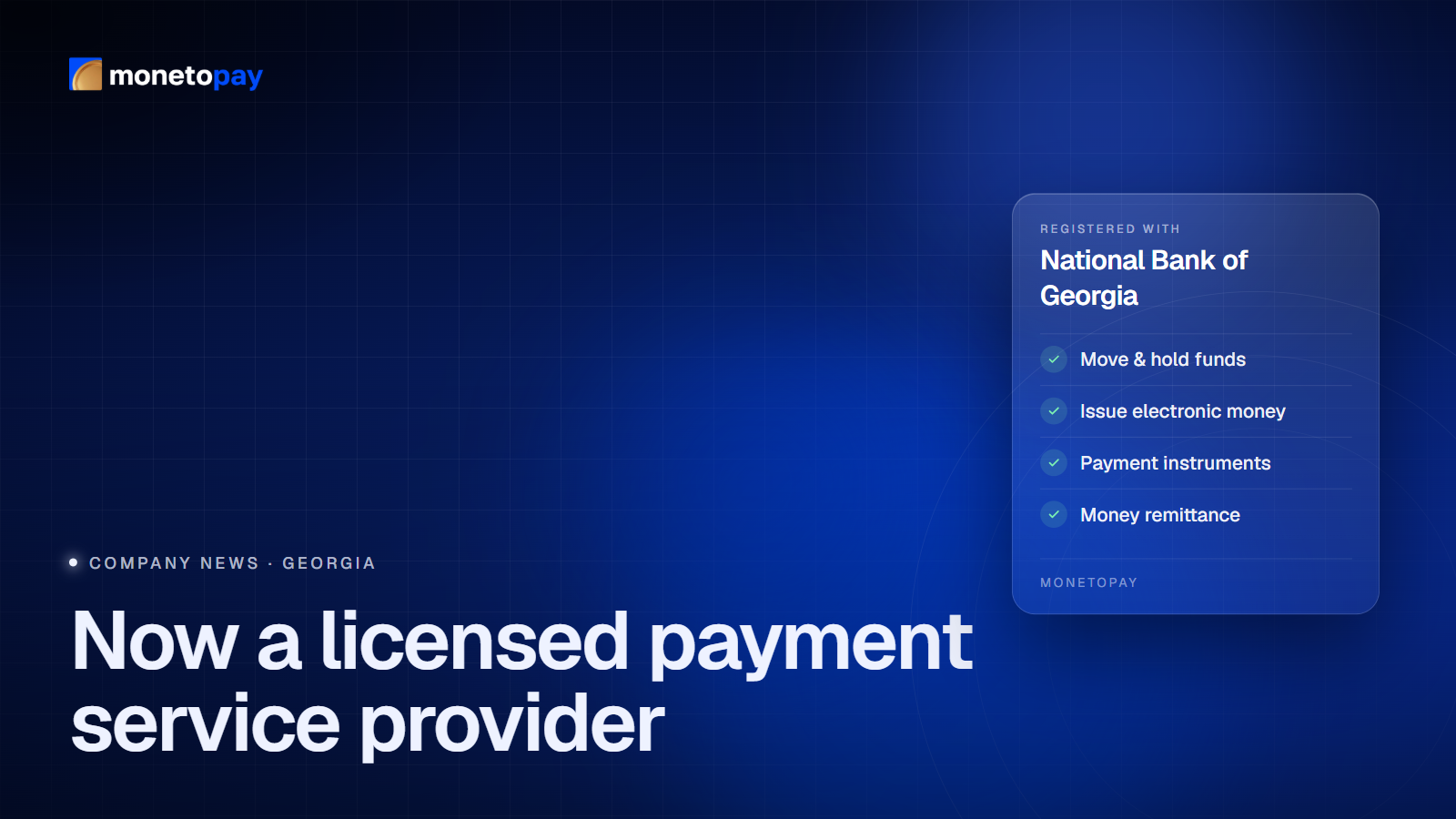
Monetopay is a payment infrastructure platform built for modern businesses that need to accept payments, manage settlements, and distribute funds across markets, without building or maintaining the underlying infrastructure themselves. Everything runs through one platform, one contract, and one set of credentials. Monetopay holds its own payment service provider licence, registered with the National Bank of Georgia.
One integration
One API · one contract
One platform
monetopay
One dashboard, every method
Card paymentsVisa & Mastercard
Wallet paymentsApple & Google Pay
Open bankingPay by bank
Pay by LinkNo-code links
SubscriptionsRecurring billing
PayoutsOutbound at scale
One integration with monetopay covers every method: cards, wallets, open banking, links, subscriptions, and payouts.
Card payments: Visa and Mastercard acceptance through a conversion-optimised checkout with built-in fraud management.
Wallet payments: Apple Pay and Google Pay with no redirect. Payment completes in the same environment the customer is already using.
Open banking: Pay-by-bank without cards, in markets where open banking infrastructure is supported.
Pay by Link: Branded payment links sent over email, SMS, or messaging, no code required.
Subscriptions: Recurring billing with trials, automatic retries, and proration, handled at the platform level.
Payouts: Outbound fund distribution to suppliers, contractors, or marketplace participants, at scale, on schedule.
Final Thoughts
A payment service provider is not a commodity. It is the infrastructure that determines whether every sale completes, how quickly funds arrive, and how well fraud is managed across every transaction channel. The choice of PSP is an architectural decision, one that will be embedded in your checkout flow, your settlement cycle, and your fraud management for years.
The fundamentals are clear: understand the transaction lifecycle, know which payment methods your customers expect, and evaluate PSPs on authorisation rates and fraud tooling rather than headline fees alone. The businesses that get this right gain a durable commercial advantage: lower abandonment, faster settlement, fewer chargebacks, and the ability to expand into new markets without changing providers.
If you are looking for a payment platform that covers every method your customers use, cards, wallets, open banking, subscriptions, and payouts, from a single integration, get in touch with Monetopay. One platform. All payment methods. One set of credentials.
Key takeaways
A payment service provider (PSP) is the infrastructure layer that moves money between a customer’s bank and a merchant’s account, handling authorisation, verification, and settlement in a matter of seconds.
Every payment passes through four key stages: data capture at the gateway, verification by the issuing bank, authorisation (hold or immediate capture), and final settlement into the merchant’s account.
PSPs sit at the centre of the payment chain, acting as the technical and commercial bridge between issuing banks, card networks, and acquiring banks.
Beyond processing transactions, modern PSPs deliver fraud detection, multi-currency settlement, recurring billing, and real-time reporting, all from a single integration.
The payment methods a PSP supports, such as cards, digital wallets, open banking, and pay-by-link, directly affect conversion rates and the markets a business can serve.
Monetopay provides a single-integration platform covering card payments, wallet payments, open banking, subscriptions, pay-by-link, and payouts, one contract, one dashboard.
Frequently asked questions
A payment gateway is the component that captures and encrypts payment data at the point of sale, the secure front end of the transaction. A PSP is the broader entity that includes the gateway function but also handles the routing, authorisation, fraud management, and settlement of each transaction. In early payment architectures, these were often separate services from different providers. Modern PSPs, including Monetopay, combine both under a single integration.
Standard card transactions typically settle within one to three business days, depending on the card scheme, the acquiring bank, and the PSP's settlement schedule. Some PSPs offer accelerated settlement for an additional fee. Open banking payments may settle faster in certain markets, as they bypass the card network and route directly between bank accounts. Your PSP should publish its settlement timelines clearly for each payment method and market.
A chargeback occurs when a customer asks their issuing bank to reverse a transaction, typically because they do not recognise the charge, claim the goods or services were not delivered, or suspect fraud. The issuing bank deducts the funds from the merchant's account pending resolution. Chargebacks carry a fee from the card scheme and can affect a merchant's processing standing if they exceed threshold rates. PSPs help by applying fraud detection that reduces the volume of fraudulent transactions, and by providing dispute management tools that allow merchants to respond to chargebacks with transaction evidence.
Yes, but using a certified PSP dramatically reduces the scope and complexity of that compliance requirement. A business that routes all card data through a PSP's hosted payment page and never stores raw card numbers handles only a small subset of PCI DSS requirements. A business that processes card data on its own servers faces a much larger compliance scope. The PSP absorbs the heaviest compliance obligations; the merchant's responsibility is to use the integration correctly and maintain the security of their own systems.
An authorisation hold reserves funds in the customer's account without transferring them. The merchant has time to review the order before completing the collection. A capture is the instruction that triggers the actual transfer of funds, either issued immediately after authorisation (immediate capture) or after a review period (deferred capture). If no capture instruction is issued within the authorisation window, the hold expires and the funds are released back to the customer.
Many PSPs support both channels, and the most efficient setups use a single provider for both. This creates unified reporting, consistent fraud tooling, and simplified reconciliation regardless of where a payment originated: online checkout, payment link, or physical terminal. Fragmented providers across channels create data silos and reconciliation overhead that grow more problematic as transaction volumes increase.
The most commercially important factor is the authorisation rate, the percentage of attempted transactions that are successfully approved. A 1-2 percentage point difference in authorisation rate can dwarf the impact of fee differences, particularly at volume. Beyond that, evaluate payment method coverage, multi-currency capability, fraud tooling quality, integration complexity, settlement speed, reporting depth, and support responsiveness. The right PSP is one that can scale with your business without requiring a provider change as volumes grow. Get in touch with Monetopay to discuss your specific requirements.
payment service providerpayment processingpayment gatewayfintech
MT
Written by
monetopay Team
Payments editorial team
Payment infrastructure team at Moneto LLC, Tbilisi
payment service providerspayment regulationB2B paymentsopen banking
monetopay is operated by Moneto LLC, a payment service provider registered with the National Bank of Georgia (reg. № 0107-7704).
Have a question, or building something with monetopay?
Reach the team directly. We usually reply same-day.